
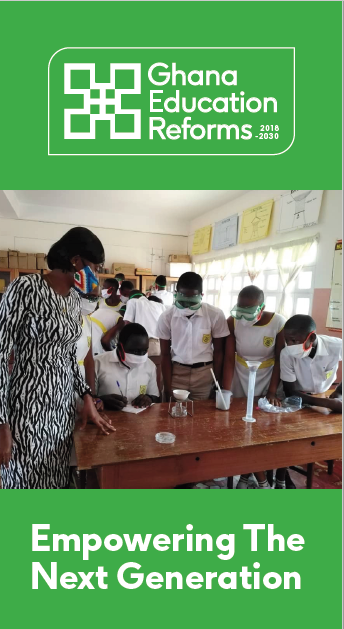
The Government of Ghana initiated some key education reforms to transform teaching and learning and improve educational outcomes under the Education Strategic Plan (ESP 2018-2030) which was approved by cabinet in November 2018. These reforms are expected to contribute to the goals of the ESP and the Sustainable Development Goals (SDG 4) and lead to the improvement of learning outcomes, especially at the pre-tertiary levels. The three main priorities of the education reforms are: Improved learning outcomes, enhanced accountability and equity at all levels of the education sector.
The main objective for embarking on these key reforms is to make our educational system relevant to changing national development priorities and renewed goals and aspirations. It is also to ensure that our educational system adjusts to context and time; as well as advancement in technologies, industry, creativity and knowledge economy. These new reform initiatives exist to provide clear performance standards to guide teaching, learning, assessment and grading of students. The reforms will professionalize teaching and ensure standards.
The Ministry of Education is coordinating the implementation of these reform initiatives through the National Education Reform Secretariat to ensure alignment and coordination of reforms within the framework of the Education Strategic Plan. The secretariat is also to ensure accountability for each reform owner, build capacity of reform owners and identify and resolve blockages, obstacles and bottlenecks to the implementation of the reforms.
Empowering The Next Generation
National Council for Curriculum and Assessment
National Teaching Council
The 12 Key Education Reform Areas Are:
Policy on Teacher Education Reforms led by the NCTE through T-TEL
Leads to the conversion of the Colleges of Education into University Colleges and the rollout of a new Bachelor of Education teacher education curriculum to improve the quality of new teachers for the basic education sector.
Pre-Tertiary Curriculum Reform through NaCCA
Leads to the design and implementation of a new pre-tertiary education curriculum with Standards and Assessment frameworks.
Legal, Institutional and Regulatory Reforms
Leads to the creation of a new agency that combines the functions of the National Accreditation Board (NAB) and the National Council for Tertiary Education (NCTE).
Tertiary Education Reform
Leads to the conversion of the National Film and Television Institute (NAFTI) and the Ghana Institute of Journalism (GIJ) into one University; and the consolidation of the Kumasi Campus of the University of Education Winneba and a few existing COEs into a Technical Teacher Training University, in addition to other governance and regulatory reforms.
Technical, Vocational Education and Training (TVET) Reforms
Realignment of all Technical and Vocational Institutions (TVIs) to be under MOE and creates a Technical and Vocational Education Service (TVES) to govern them.
Operationalization of Pre-Tertiary Teacher Professional and Management Development Framework through NTC
Leads to the establishment of a teacher licensing and registration system in Ghana, and a framework for teacher career progression based on the acquisition of skills and competencies.
Introduction of a new school supervision and inspection system through NIB
Leads to the establishment of a new inspection framework, inspection tools and revised inspection protocols, in partnership with Education Development and OFSTED.
Basic Education Decentralisation Reform
Leads to the devolution of Basic Education to District Assemblies, impacting the functions of the GES, NTC, NaCCA and NIB.
Ghana Partnership School
Leads to MOE and GES partnering with non-state actors to manage and deliver effective education service in public senior high schools.
GES Institutional and Human Resource Reform
Leads to the streamlining of GES’s operations to increase efficiency and reduce the redundancies resulting from Basic Education decentralisation, and a comprehensive reform of HR systems.
ICT in Education Reforms
Seeks to develop early desire and competences in children to use ICT, equip pre-tertiary learners with ICT skills, infuse ICTs into education management, and transform teacher development and tertiary education through technology-based training.
Secondary Education Reform (4 Pillars)
With the Free SHS Programme, MOE seeks to absorb all fees paid at the senior high school level, and additionally to expand physical infrastructure, improve quality, and promote skill development and equity.
These reforms are aligned to the Education Strategic Plan (2018-2030), and are designed to strengthen the sector institutions to overcome their capacity gaps, and accomplish the goals outlined in the Education Sector Plan. The end goals of these reforms are “to deliver quality education service at all levels that will equip learners in educational institutions with the skills, competencies and awareness that would make them functional citizens who can contribute to the attainment of the national development goals.”
The Ministry of Education intends to deliver these reform initiatives through a coordinated approach and is expected to create linkages and co-dependencies between the different sub-sectors for the successful implementation of the ESP. The National Education Reform Secretariat (NERS) was therefore set up and charged with the mandate to ensure that these reforms are not just delivered at a national level (through the production of a curriculum or legal and policy documents) but that they are effectively implemented throughout the system so that they have a positive impact on learning outcomes in schools. Continue reading