
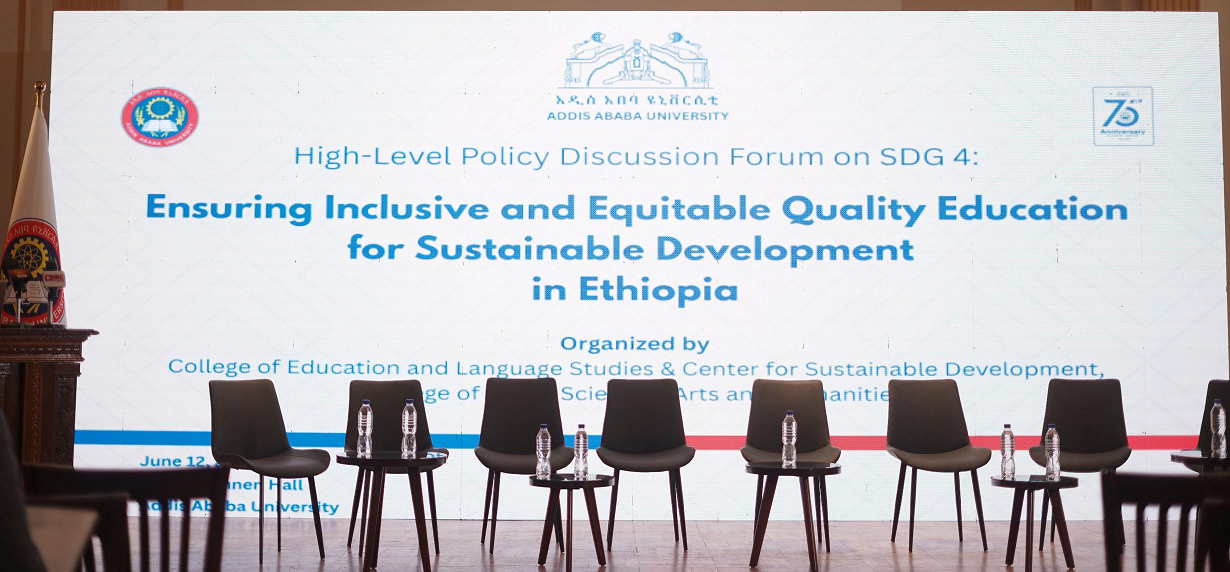
College of Education and Language Studies and the Center for Sustainable Development at the College of Social Sciences, Arts and Humanities at Addis Ababa University coordinated a pivotal national policy discussion forum on Sustainable Development Goal 4 (SDG4), focusing on ensuring inclusive and equitable quality education for sustainable development in Ethiopia.
The event took place at the Ras Mekonnen Hall and gathered a diverse group of stakeholders, including policymakers, educators, and international partners, to engage in critical dialogue about the current state of education in the country.
The forum highlighted that Ethiopia has made remarkable strides in expanding access to education across all levels. However, these gains have been significantly undermined by a multitude of pressing challenges including manmade and natural catastrophes like internal conflicts and the COVID-19 pandemic. These led millions of Ethiopian children remain out of school, and many others face the risk of dropping out.
Samuel Kifle (PhD), Interim President of AAU, addressed the unwavering commitment of the University to inclusive and quality education as a cornerstone of Ethiopia’s development. He stated that AAU views SDG4 as an institutional imperative intricately woven into the University’s strategic plan of 2024 – 2028.
Dr. Samuel encouraged participants to leverage the forum as a platform for coordinated efforts and to advocate for evidence-based, context-specific policy strategies. He stressed the importance of collaboration among all stakeholders to ensure that the intentions behind SDG4 translate into tangible accomplishments.
“The SDG4 promises a strong and prosperous Ethiopia, where every child, youth, and adult has the opportunity to learn, grow, and contribute to the future of this great nation,” he affirmed.
Jeilu Oumer (PhD), Academic Vice President at AAU, underscored the critical need for a comprehensive evaluation of Ethiopia’s educational landscape posing a pivotal question to the audience whether we are truly equipping Ethiopia’s youth for the challenges and the opportunities of the 21st century.
This inquiry set the stage for a thorough examination of the nation’s progress toward achieving the sustainable development goals in higher education, focusing on both accomplishments and ongoing challenges.
Dr. Jeilu emphasized the importance of SDG4, which highlights quality education and lifelong learning as fundamental components of the 2030 Agenda. He articulated the necessity for a strategic framework that aligns higher education with the evolving demands of the global economy and meets the specific needs of Ethiopian society.
Quentin Wodon (PhD), Director of the UNESCO International Institute for Capacity Building in Africa (IICBA), delivered a keynote address which aimed to foster dialogue on ensuring inclusive and quality education, highlighted both the challenges and opportunities facing the educational sector in the region.
Dr. Wodon emphasized the critical need for progress in achieving SDG4, which mandates that all children receive access to primary and secondary education. He underscored that while some advancements have been made so far, they are insufficient to meet the ambitious targets set forth by the United Nations.
The forum served as a vital gathering for dialogue on the future of education in Ethiopia. Participants acknowledged the significant achievements made in expanding access to education but also recognized the critical barriers that remain. The discussions emphasized the urgency of adopting innovative strategies and fostering collaborative efforts among all stakeholders in the education sector.